
Reflections from New York on what education owes a person and why the answer matters for the way we fund, build and use technology.
By Jonathan Frederick
Founder, STAARK Educational Solutions
September 17, 2026
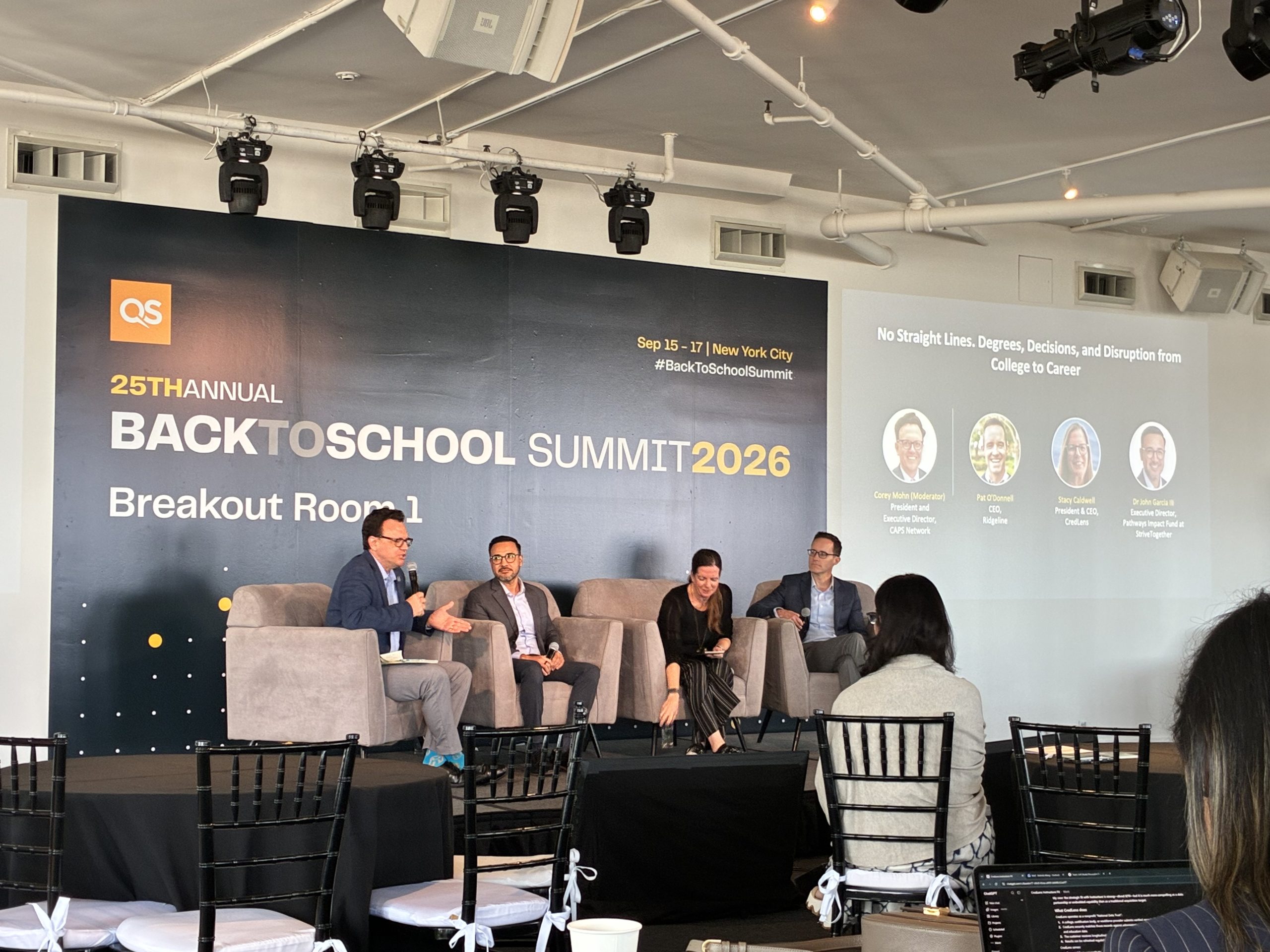
At the Back to School Summit in New York on Thursday, I asked a question that brought a conversation about employment outcomes back to the humanities.
Are we preparing students for their first job, or their fifth?
I had begun with a simpler proposition: to me, education is life. The same concern that makes us question teaching narrowly to a test should make us cautious about designing an education narrowly around a first job. Assessment matters. Employment matters. Neither, on its own, tells us everything about the person being educated.
The response from the panel returned to general education, critical thinking, collaboration and the humanities. What sounded like a challenge to the direction of higher education was, in another sense, a defense of one of its oldest purposes.
That exchange stayed with me through the final day of the summit, which brought education, technology, investment and workforce leaders together at Tribeca Rooftop + 360°. Across discussions about student mobility, patient capital and AI-enabled research, I began to hear a common question beneath the different professional vocabularies: how do we deliver something useful now without diminishing what becomes possible later?
The first job matters
There is an easy version of the argument for a broader education, and I do not find it convincing.
It dismisses salaries, internships and employment outcomes as though worrying about them reveals a failure of imagination. For a student balancing tuition, paid work and family responsibilities, a reliable income is hardly a narrow aspiration. It can mean the freedom to make choices that were previously unavailable.
After seven years in public-school classrooms in Baltimore and Washington, D.C., I have little interest in an account of education that treats material security as somebody else’s problem.
Some of the most compelling work discussed at the summit addressed precisely that problem.
The Rutgers–Newark presentation described an institution thinking carefully about the students it actually serves: commuters, working students, parents and people whose lives do not fit a conventional residential-college timetable. Its discussion of student journey mapping focused on finding the points where institutional processes make an already demanding life harder.
The practical implications are easy to miss. A service can exist and still be inaccessible. An opportunity can be advertised and still require knowledge, time or confidence that a student has not yet acquired.
Rutgers–Newark’s partnership with Braven offers one response. It brings coursework, mentorship, professional connections and career support into the student experience, with an explicit emphasis on building social capital alongside workplace skills.
CUNY’s career-infused degree maps address a related problem. They place career activities alongside academic requirements, making the work of preparing for employment part of a student’s route through a degree rather than something to discover shortly before graduation.
There are encouraging early results. CUNY reports that, over three years, its College of Staten Island computer-science department saw a 144 percent increase in the number of students with full-time jobs at graduation alongside the use of these maps. Its published guide describes the results as correlated changes—a useful distinction, because improvement does not establish that a single intervention caused it.
What interests me is the underlying design: make the route more visible, connect academic work with opportunity, and stop assuming that every student arrives knowing how to navigate the institution.
None of that requires reducing education to employment preparation. In fact, doing it well may give students more room to explore.
The danger comes when the first destination becomes the entire definition of success.
What happens after the offer letter?
A graduate can be well prepared for a particular role and poorly prepared for what happens when that role changes.
Someone else may take an indirect route into work yet carry an education that helps them learn a new field, challenge an assumption, manage disagreement or recognize that a promising opportunity is not the right one.
My question about the fifth job was not a prediction about how many jobs people will hold. It was a way of extending the institution’s field of vision.
What will remain useful when the software changes? When a graduate becomes responsible for other people? When an industry contracts? When family circumstances require a different kind of work? When someone decides that the career they once wanted is no longer the life they want?
These are practical questions, even when they resist a neat placement statistic.
They also explain why I find the opposition between career preparation and the humanities so unhelpful. Close reading can involve learning to distinguish evidence from assertion. Historical study can require holding competing explanations in view. Writing can expose the point at which an apparently clear idea becomes confused. Those activities deserve attention in their own right; they also offer ways to practice judgment.
But the defense should not stop at a reassuring claim that a broad education somehow produces adaptable people. Institutions should be able to show where students practice these abilities, how they receive feedback and how they apply them in unfamiliar settings.
Adaptability is not a substitute for knowledge. It depends on having something substantial to think with.
Nor does it belong exclusively to one category of degree. A technical program can cultivate judgment and curiosity. A humanities program can fail to do so. The question is what students are actually asked to understand and do.
The ambition should be to help someone enter the world of work without treating their first employer’s requirements as the outer boundary of their education.
Education runs on more than one clock
The patient-capital discussion gave this tension a different vocabulary.
Lemnis offers an alternative to investment organized primarily around a future exit. As a public charity, it brings mission-aligned organizations into its collective through mergers and acquisitions, pairing patient capital with operational and strategic support. Its wider approach also includes grants and investments.
Joshua Elder of Siegel Family Endowment described philanthropy’s capacity to support uncertain, early work. The foundation’s own formulation—“society’s risk capital”—captures the possibility of backing questions before conventional evidence or commercial incentives make them easy to fund. Its approach is inquiry-driven: form a hypothesis, investigate it, interpret the results and use what has been learned to shape the next decision.
What I found important was the insistence that patience still requires movement.
In the discussion, a learning agenda mattered: what are we trying to discover, what evidence are we gathering, and what would make us change course? Long-term ambition was not presented as permission to avoid scrutiny.
That distinction deserves more attention in education.
A short funding cycle can reasonably require evidence that work is progressing. It cannot reasonably reveal every consequence of an intervention intended to influence a young person’s life over many years. Equally, an organization should not be able to invoke those distant possibilities indefinitely while learning nothing in the present.
We need ways to examine progress without pretending that early indicators are final outcomes.
The conversation also turned toward work that rarely makes the most attractive pitch deck: research, test environments, technical infrastructure, procurement and the capacity to implement something reliably.
I kept thinking about how much depends on that work. A school may be interested in an idea but unable to integrate it into its routines. A promising organization may need stronger operations as urgently as it needs a larger audience. A product may need a careful evaluation before anyone should be encouraged to scale it.
Those are not minor matters to be resolved after innovation. They help determine whether the innovation amounts to anything.
The clocks are different. A company needs revenue. A funder needs a basis for its next decision. A school needs something workable this term. A learner needs support now and capabilities that endure.
The task is to connect those obligations without allowing the shortest deadline to define the longest purpose.
Remove the obstacles, preserve the thinking
The research discussion brought the same issue into the age of AI.
Panelists considered how AI fits into literature reviews, coding, data preparation and other parts of the research process. They repeatedly returned to questions of validation, interpretation, disclosure and responsibility.
For me, the important distinction was between completing a task and understanding what its completion means.
Imagine a student submitting a polished analysis that they cannot explain. The document may be finished, but the educational work is not. Imagine a researcher receiving a plausible result without being able to account for the assumptions behind it. Speed has not settled the question of whether the finding deserves trust.
This is not an argument for making education unnecessarily difficult. It is an argument for distinguishing different kinds of difficulty.
An inaccessible form, an appointment offered only during a student’s working hours, or a system that requires a parent to repeat the same information several times creates obstacles to participation. Those are burdens worth removing.
The effort involved in comparing evidence, revising an argument or working out why an answer is wrong can serve a different purpose. Removing that effort indiscriminately may remove an opportunity to learn.
The goal should be to reduce avoidable burdens while supporting the intellectual work that builds understanding.
AI can be part of that support. A tool might offer feedback, suggest a counterexample, help someone organize an investigation or make an unfamiliar concept more approachable. The educational question is what the learner comes to understand through the interaction, including what they can explain or apply afterward.
That is a more demanding standard than asking whether the output looks impressive.
It also changes what I would want to hear from an education company. Beyond a demonstration, I would want to understand the learning purpose, the role of the educator or parent, the evidence being collected and the response when the tool gets something wrong.
Whatever the next generation of systems can do, institutions still have to decide what they will accept as evidence and who will be accountable for acting on it.
The work after the conference
By the end of the day, I was less interested in declaring a winner between competing models of education than in understanding what it would take to make the strongest ideas work together.
Help students find employment. Give them reasons and opportunities to develop beyond their immediate occupational plans. Use technology where it assists that work. Fund the evidence and operational capacity needed to know whether it does.
Then answer the ordinary questions.
Who follows up with the student? Who notices when a plan is not being used? Can a parent understand the recommendation? Does a teacher have time to act on it? What happens when the circumstances change?
This is where my work at STAARK begins. Our current parent-facing platform is designed to turn an educational concern into a practical daily plan that parents can review, adjust and revisit as they assess progress.
The standard I want to hold that work to goes beyond generating a convincing plan. It must concern what people can realistically do with it, what happens next and what we learn from the result.
The same distinction applies at institutional scale. A referral is not the same as support received. A partnership announcement does not tell us whether students can access the opportunity. A newly available tool does not establish that anybody’s education has improved.
For schools, families and the organizations working with them, implementation is the point at which a claim encounters someone’s actual life.
There was a quieter reminder of that over these two days. Some of the conversations I most enjoyed were about nature, travel, ships and life beyond professional titles. They were worthwhile without needing to become something else.
I do not see that as separate from the argument about education. A person should be able to earn a living, but also to find interests, form relationships, question their direction and participate in a world larger than their occupation.
We should take the first job seriously enough to help students reach it.
We should take the rest of their lives seriously enough not to stop there.